
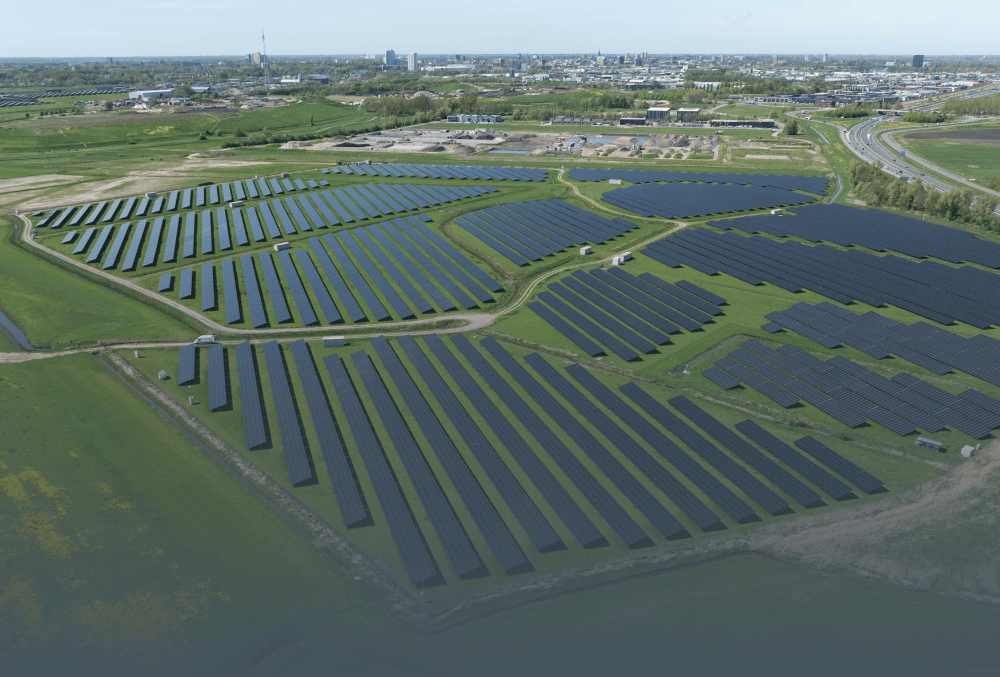

Solar parks are increasingly targeted for copper theft, sabotage, vandalism and intruders. At the same time, the demands of insurers, investors and asset managers are becoming stricter. A well-thought-out solar farm security strategy is therefore no longer a luxury., but an essential part of risk management and business continuity.
Yet in practice, traditional security solutions often prove inadequate. Motion detection causes false alarms, Mortuaries are becoming overloaded and remote locations make prompt follow-up difficult. Especially with large-scale solar farms, the consequences of a security incident can be significant: from loss of production to insurance problems and high recovery costs.
A solar park often consists of large, remote sites with kilometres of cabling, technical installations and vulnerable infrastructure. Precisely that combination makes solar parks interesting to criminals.
Common risks include:
In addition, many solar farms are located outside urban areas, which limits physical surveillance and does not always allow for rapid follow-up.
This brings for asset managers and investors direct financial risks This entails. Downtime of a solar park not only means a loss of energy yield, but can also have consequences for contractual agreements, insurance and operational costs.
Many solar farms still use standard camera surveillance with traditional motion detection. In theory, this seems sufficient, but in practice, it causes many problems.
During bad weather, moving vegetation, animals, or shadows, unnecessary alarm notifications regularly occur. Especially with large perimeter zones, this leads to a huge amount of false alarms.
This has several consequences:
With traditional solar farm security, the focus is often on detection. Modern AI security, on the other hand, concentrates on classification and filtering. That difference is crucial.
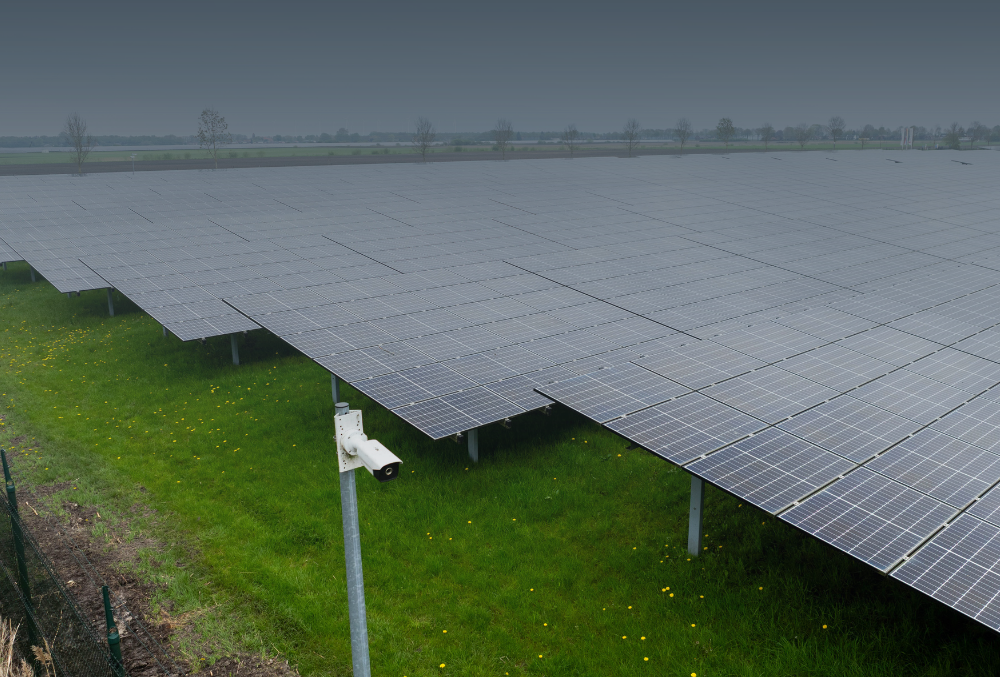
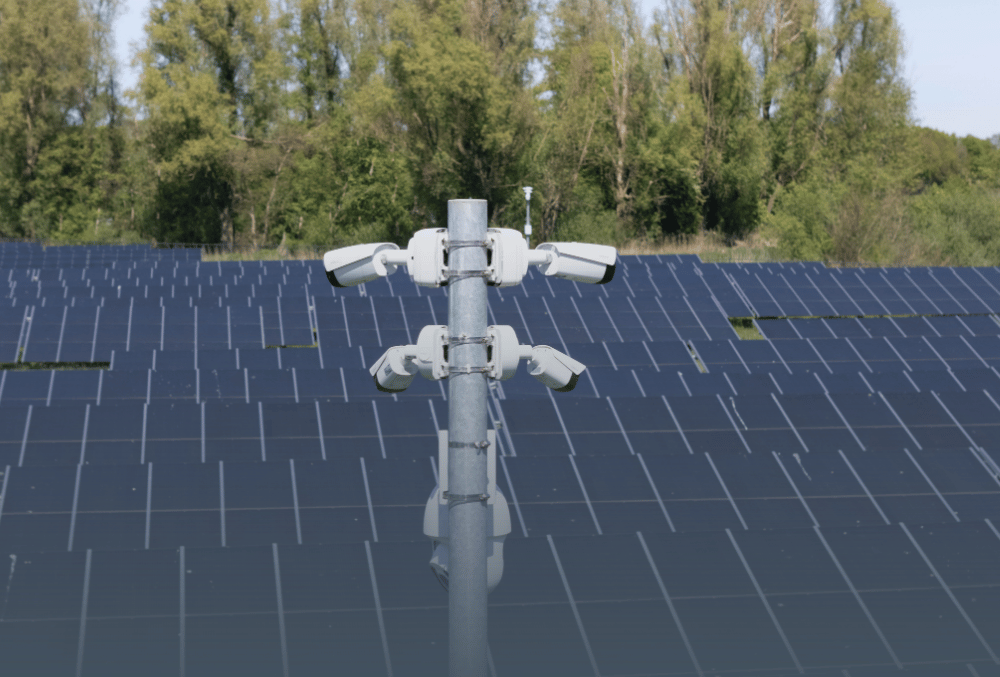
Effective security for solar farms consists of multiple layers that work together.
The first line of defence usually consists of perimeter security. This involves continuously monitoring the outside of the premises via cameras, Fence detection of intelligent detection software.
The aim is to detect intruders early on before they reach critical parts of the solar farm.
AI surveillance distinguishes between:
This automatically filters out irrelevant movements, significantly reducing false alarms. Where traditional detection reacts to movement, AI analyses the behaviour and type of object being observed.
Thermal cameras detect heat differences and also function:
Thermal detection has therefore become increasingly important for solar parks and battery storage sites.
In modern solar farm security, alerts are verified in real time. This allows for a quicker determination of whether there is:
This prevents unnecessary follow-up and increases the efficiency of control rooms.
Within critical energy infrastructure, the role of AI is rapidly growing. Not because AI “sounds smarter,” but because traditional systems struggle with the scale and complexity of modern solar farms.
AI security partially helps with:
This offers operational advantages, especially for large solar farms.
With traditional solar farm security, a single night can generate dozens of false alarms due to weather conditions or animals. AI systems largely filter these notifications out.
This lowers:
When operators receive fewer irrelevant notifications, genuine threats can be addressed more quickly. This enhances the effectiveness of the entire security chain.
Insurers are taking an increasingly critical look at the security of solar parks. Especially with larger projects, additional security requirements are more often being made mandatory.
Think about:
For investors, good solar farm security is therefore not only important from a safety perspective, but also from Compliance and insurability.
In cases of insufficient security, the following may occur:
A large solar farm outside a built-up area experienced dozens of alarm notifications daily. Moving vegetation, weather influences, and small animals continuously triggered alerts.
This led to several problems:
Upon implementation of AI object recognition and smart filtering the number of false reports decreased drastic. Only relevant notifications were forwarded to the control room. For operators, this meant more overview, less workload, and faster follow-up.
The energy transition ensures that solar farms play an increasingly important role in energy supply. This also increases the importance of security.
Solar farms are increasingly seen as:
This also changes the way security is approached.
Where previously the focus was mainly on basic camera surveillance, modern security now revolves around:
Modern solar park security is no longer just about installing cameras. The combination of critical infrastructure, escalating risks, and stricter insurance requirements demands a more intelligent approach.
Traditional detection systems often generate too many false alarms and inefficient follow-up. AI security, perimeter detection, and thermal analysis make it possible to secure solar farms more reliably and efficiently.
For asset managers, investors and operators, security is therefore increasingly becoming part of operational risk management.
Soldefence supports organisations in securing energy assets with smart AI security, real-time detection and solutions focused on reducing false alarms. Want to know more? Please feel free to get in touch.
An effectively secured solar farm combines perimeter security, AI camera surveillance, thermal detection, real-time monitoring, and smart filtering against false alarms. An integrated approach works better than standalone security components.
While CCTV is not always legally mandatory, insurers are increasingly imposing additional security requirements. CCTV is often required, especially for larger solar farms.
Traditional motion detection often reacts to animals, shadows, rain, wind, and vegetation, leading to many unnecessary alerts. AI filtering helps to significantly reduce these notifications.
For solar farms, combinations of thermal cameras, PTZ cameras, AI cameras, and perimeter detection systems are often used. The correct choice depends on the land area, location, risk analysis, and insurance requirements.
AI assists with real-time object recognition, filtering of irrelevant movements, reduction of false alarms, more efficient control room processes, and better detection of genuine threats.
Sources:
International Energy Agency (IEA). (2024). Renewables 2024 Report.
NIST. (2024). Framework for Improving Critical Infrastructure Cybersecurity 2.0.
Kiwa. (2023). BRL guidelines for security and installations.
© Soldefence 2025 | Online realisation: 050 Marketing
 Nederlands Nederlands
  English (UK)
 Deutsch
 Polski
 Español