
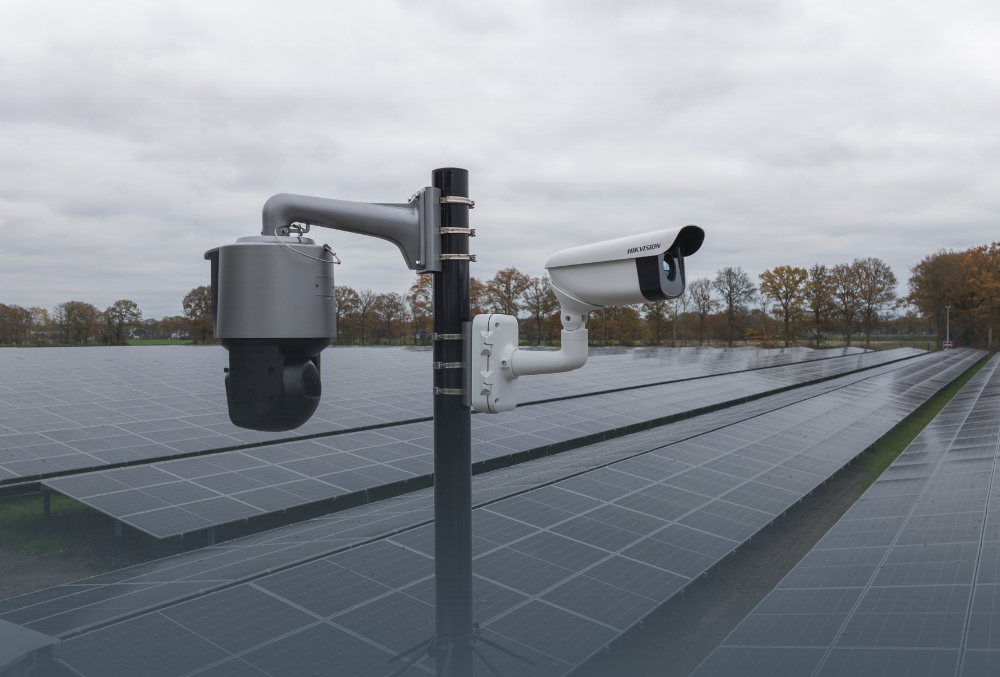

A solar park often represents an investment of millions of euros. Yet many locations turn out to be surprisingly vulnerable to copper theft, vandalism, sabotage and unauthorised access. As a result, asset managers, investors and operators are increasingly facing the same question: is CCTV surveillance mandatory for solar parks?
The short answer is: legally it is Usually not fully compulsory, but in practice, CCTV surveillance is increasingly being demanded by insurers, financiers, municipalities, and operators.
There is growing pressure to implement professional security measures, particularly for large-scale solar farms, battery storage sites, and other forms of critical infrastructure. The market is rapidly shifting towards AI security, perimeter detection, and thermal imaging.
For operators of energy assets, this is no longer just a security issue, but also a financial and operational risk.
Solar farms are often located in remote areas. This makes them attractive to criminals. Copper theft, inverter theft, and sabotage in particular are becoming increasingly common within Europe.ENISA, 2023)
The consequences extend beyond mere material damage. An incident can lead to:
Operational disruptions and theft are among the main business risks, according to international analyses such as the Allianz Risk Barometer. At battery storage sites, the risks increase further. Fire hazards, overheating, and sabotage also play a role there.
This creates a new reality for asset managers and operators: traditional fencing and standard cameras are no longer sufficient.
In the Netherlands, there currently exists no general law which explicitly states that CCTV is mandatory for solar parks.
However, more and more operators are seeing that CCTV surveillance is being made mandatory by insurers and investors.
In practice, obligations arise via:
Security is increasingly becoming part of comprehensive risk analyses, particularly for large-scale solar farms.
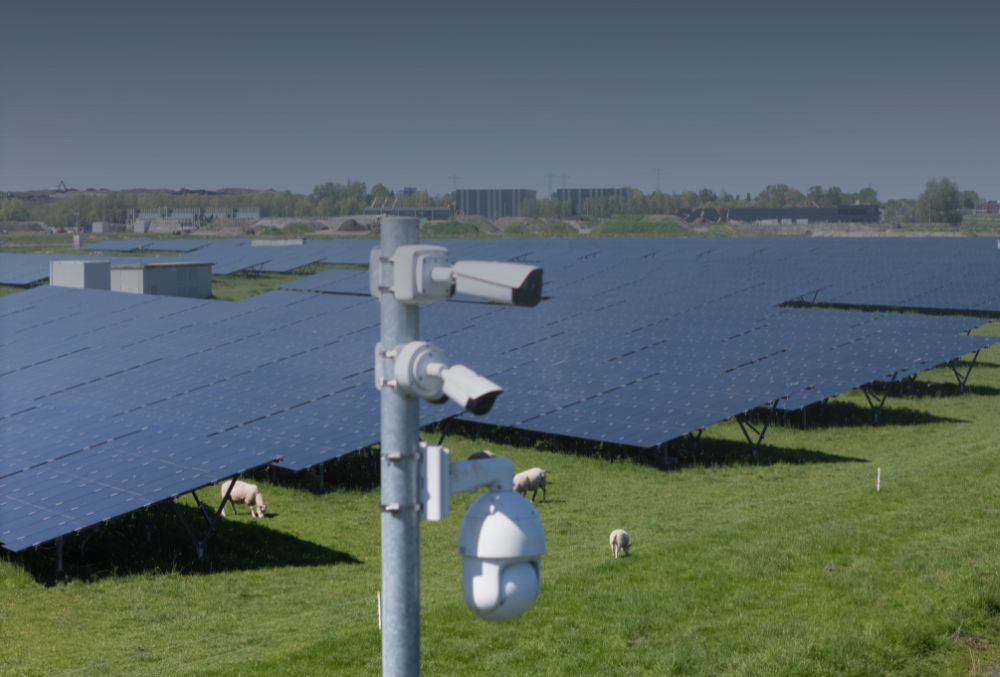
Many insurers nowadays only accept a solar farm under certain conditions. This is especially the case when:
Thereby, CCTV surveillance is often indirectly made mandatory in policy conditions. Not always literally as a “requirement,” but rather as a condition for coverage or premium reduction.
In many cases, insurers require 24/7 camera surveillance, connections with control rooms, and thermal detection. If these measures are missing, it can have consequences for the insurability of the solar farm.
Many solar parks still use a standard Video Management System in combination with motion detection. On paper, that seems sufficient, but in practice, this regularly causes problems.
Traditional detection systems often react to movements that do not pose a real threat. Consider animals, moving vegetation, rain, shadows, or light reflections. This can lead to a huge number of false alerts, especially on large sites.
This creates a serious problem for control rooms. When operators receive hundreds of irrelevant notifications daily, their alertness decreases. Real incidents are then less likely to be recognised or followed up on.
Within the security sector, this is also known as alert fatigue.
This is precisely why more and more operators are switching to intelligent AI security. Not because it's a technological trend, but because traditional systems are proving to be increasingly less effective operationally.
In modern solar farms where camera surveillance is a mandatory part of the security plan, AI plays an ever-increasing role. AI security analyses camera footage in real-time and can distinguish between people, vehicles, animals, and environmental influences. That sounds simple, but technically, it makes a big difference.
Where traditional systems purely react to movement, AI looks at behaviour, patterns, and object recognition. This allows the system to better determine if there is actually a threat.
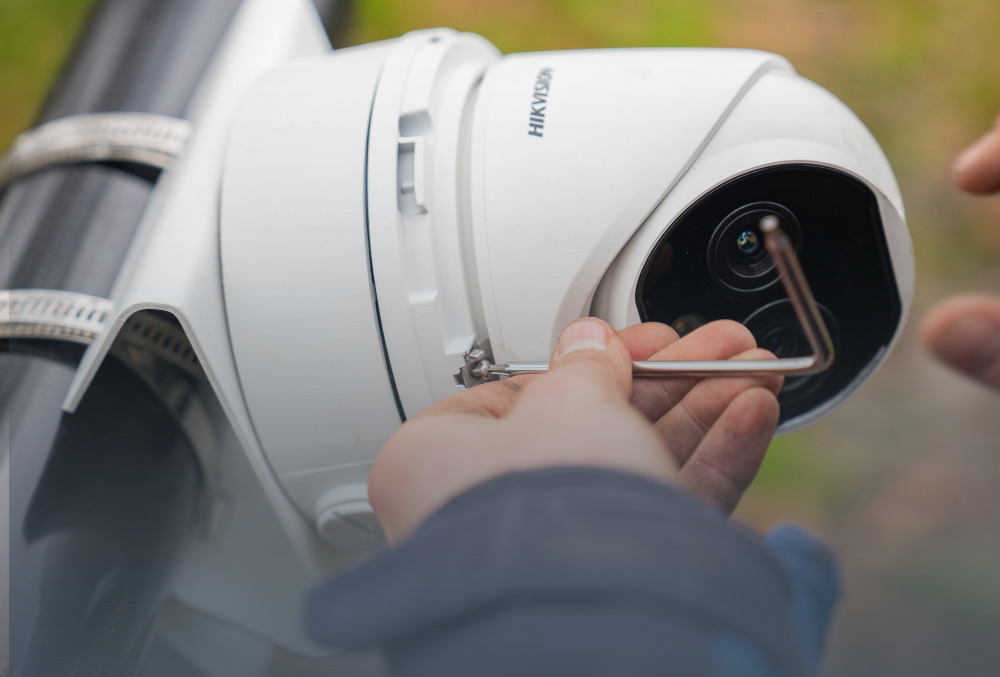
Modern solar farm security often combines multiple technologies. Think of:
When someone enters an area, the system immediately analyses what is happening. Only relevant alerts are forwarded to the control room. This significantly reduces the pressure on operators and ensures that security guards can respond more quickly to real incidents.
For asset managers, this offers several advantages. Not only does the number of false alarms decrease, but operational costs can also be reduced by organising security more efficiently.
According to the International Energy Agency (IEA) The role of solar energy and battery storage is growing rapidly within the European energy supply. Whereas solar farms were previously mainly seen as renewable energy projects, they are nowadays increasingly being considered as part of critical infrastructure.
This means that disruptions can have greater societal consequences.
Within Europe, therefore, attention is growing for sabotage, organised crime, and physical security of energy assets. As a result, governments, investors, and grid operators are examining security strategies ever more critically.
For investors, security is also playing an increasingly important role in risk assessments. A solar park without a professional security strategy may become less attractive to financiers or entail higher operational risks.
At a solar park in Europe, criminals managed to remove several copper cables during the night. Although CCTV surveillance was in place, the system proved to be virtually ineffective in practice.
The cameras exclusively operated based on motion detection.
Vegetation continuously caused notifications, leading to control room operators receiving dozens of false alarms daily.
When there was actually a burglary, the report was not taken seriously straight away.
The final cost of the damage ran into tens of thousands of euros due to repair work, loss of production and operational delays.
Following the incident, the site was fitted with AI security and thermal detection systems. The number of false alarms fell sharply straight away, and the response to suspicious situations improved significantly.
Situations like this show why CCTV surveillance alone is often no longer enough. It is increasingly a question of the quality of detection and analysis.
Battery storage is generally subject to stricter safety requirements than solar panels. This is because battery storage:
This increasingly leads operators to opt for thermal cameras that can detect temperature differences in real-time. This allows deviations to be signalled early before situations escalate.
Investors have long since stopped focusing solely on yield calculations and energy production. Operational continuity, security strategy and insurability also play a significant role these days.
A solar farm without a professional security approach can therefore be seen as riskier. This can affect financing terms, investment willingness, and the final value of a project.
For asset managers, this means that solar farm security is increasingly becoming an integral part of professional risk management.
A frequently asked question is whether CCTV surveillance at solar parks raises issues under privacy legislation. Even when CCTV surveillance is made mandatory by insurers or operators, strict compliance with privacy legislation remains essential.
In most cases, CCTV is permitted, provided it is used proportionally and complies with GDPR regulations. As solar farms are usually not public locations, this is often legally simpler than for CCTV in urban areas.
However, it remains important to keep visitors informed, store images securely and apply retention periods correctly.
Is camera surveillance mandatory for solar farms? Legally, usually not, but in practice, professional camera surveillance is quickly becoming standard within the energy sector.
At the same time, the market is clearly shifting towards smart AI security, with a focus on real-time analysis, reducing false alarms and intelligent perimeter security.
Soldefence supports operators, asset managers, and investors with advanced security solutions for solar farms, wind farms, and battery storage, focusing on continuity, risk management, and operational reliability. Want to know more? Please feel free to get in touch.
No, there is no general legal obligation. However, in practice, insurers and investors are increasingly imposing security requirements, making CCTV surveillance necessary.
AI security combined with perimeter security, thermal detection, and links to monitoring centres is being chosen more and more often.
Traditional systems often react to movements of animals, vegetation or weather influences. This results in many irrelevant notifications.
The investment is often higher, but operational costs can actually decrease due to more efficient control rooms and damage prevention.
Battery storage entails additional risks, such as fire hazards, sabotage, and impact on grid stability.
Sources:
ENISA Threat Landscape 2023 | ENISA. (2025, 6 November). https://www.enisa.europa.eu/publications/enisa-threat-landscape-2023
Allianz (2024, September) https://commercial.allianz.com/news-and-insights/reports/emerging-risk-solar-power.html
International Energy Agency (n.d.) https://www.iea.org/
© Soldefence 2025 | Online realisation: 050 Marketing
 Nederlands Nederlands
  English (UK)
 Deutsch
 Polski
 Español